How Big Should a Hay Barn Be? Sizing for Round and Square Bales
Size a hay barn by working backward from your bales: how many you put up, how you stack them, and the room your loader needs. Here’s the math, with a worked example.
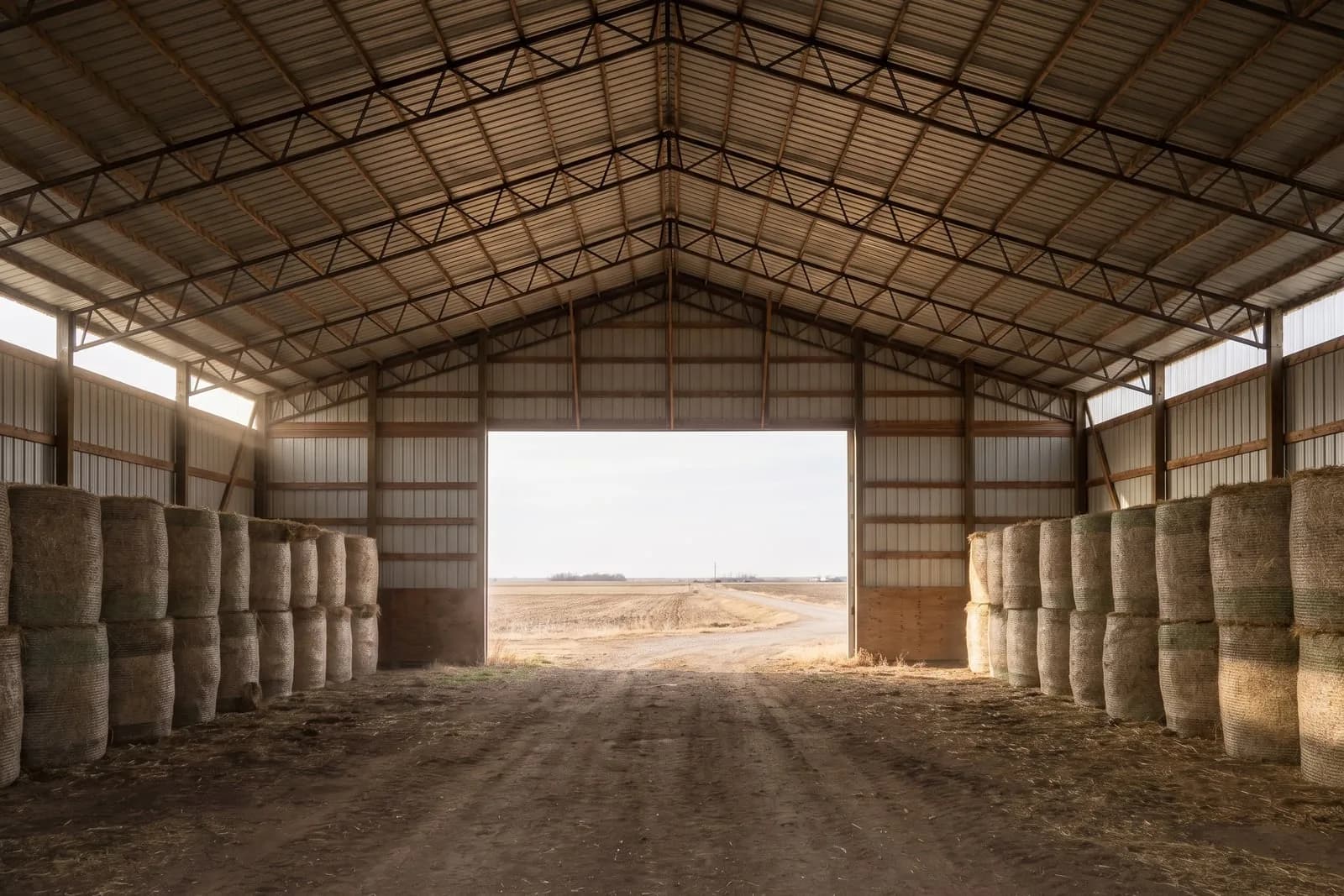
Most hay barns get sized by a guess, and most people who guess end up wishing they had gone bigger. A better way is to work backward from the hay: how many bales you put up in a year, what size they are, how you stack them, and how much room your equipment needs to get in and out.
Start with your bales
Measure the bales you actually make or buy. Common sizes:
- Round bales: usually 4 to 5 feet wide and 4 to 6 feet across. A 5×6 bale (5 feet wide, 6 feet across) is a common size.
- Large square bales: often 3×3×8, 3×4×8, or 4×4×8 feet.
- Small square bales: roughly 14 by 18 inches and about 3 feet long.
Decide how you will stack
How you stack changes the footprint more than anything else.
- Round bales on end take a square footprint about as wide as the bale is across. A 5×6 bale standing on end needs about 6 by 6 feet, or 36 square feet, and stands 5 feet tall.
- Round bales on their sides can be stacked in a pyramid, but bales in the middle are harder to pull, and the bottom row carries the weight.
- Large squares stack tight and high, and use floor space the most efficiently.
Only stack as high as your loader can safely reach and set.
Leave room to work
A barn full of hay you can’t get to isn’t much use. Plan an aisle or an open side wide enough to turn the tractor and loader, and enough room at the bays to pull bales without backing into a post. A clear-span steel frame helps here because there are no interior posts to work around.
A worked example
Say you put up 240 round bales a year, each 5 feet wide and 6 feet across, and you stack them on end two high.
- 240 bales ÷ 2 high = 120 spots on the floor.
- 120 spots × 36 square feet = 4,320 square feet of hay.
- Add about 20 percent for working room, and you’re near 5,200 square feet.
A 60×90 building (5,400 square feet) covers that with a little to spare. Two bales on end stand about 10 feet tall, so leave room above the stack for the loader to lift and set the top bale. Many hay barns end up between 14 and 16 feet at the eave, but the right number comes from your loader’s reach.
Plan for next year
Herds grow, a wet year means carrying more hay, and a good crop leaves extra. If you’re near the edge of a size, go up one. You can add a lean-to later, but building the right size once is usually simpler.
Open or enclosed?
Many hay barns are open on one or more sides for easy access and airflow. A wind wall on the side that takes the weather keeps rain and snow off the hay while leaving the working sides open. RM Steel builds both open-frame and fully enclosed agricultural buildings, and every one is engineered to your county’s snow and wind loads.
Get the size right the first time
Try your layout in the RM Steel 3D Designer, or send us the basics: how many bales, what size, and how you stack them. We’ll help you size it.